There is something quietly powerful happening every weekend morning across America.
Before the heat sets in and before schedules take over, people gather in parking lots, parks, and town squares. Not for a game, not for a sale; but for something slower, simpler, and meaningful. The farmer’s market.
At first glance, it might look like a modern trend with canvas totes slung over shoulders, fresh flowers bundled in brown paper, homemade sourdough stacked neatly beside jars of honey, but the truth is farmer’s markets are anything but new. In fact, they are one of the oldest forms of commerce in human history.
Long before grocery stores, refrigeration, or global supply chains, communities depended on local markets as their primary source of food and goods. Farmers, bakers, and artisans would gather in central locations to sell what they had grown or made. These markets weren’t just about transactions either. They were about relationships. They were where people exchanged stories, news, and trust along with their goods.
In many ways, what we’re seeing today is a return.
It’s a return to connection.
In a world built on convenience, we’ve started to feel the cost of it. Pre-packaged meals, one-click ordering, and drive-thru dinners have made life faster but not necessarily fuller. The farmer’s market gently resists that pace. It invites us to slow down, to ask questions, to meet the person behind the product. There’s something grounding about shaking the hand that grew your food or hearing how a family recipe turned into a small business.
It’s a return to trust.
For decades, the American food system has prioritized efficiency and scale. While that has brought affordability and access, it has also created distance between us and what we consume. Labels have replaced conversations. Ingredients have become harder to recognize. At a farmer’s market, that distance disappears. You know where your food comes from, and I don’t just mean geographically, but personally. That kind of transparency builds a different kind of confidence, one rooted in relationships rather than branding.
It’s a return to simplicity.
There is a quiet clarity in food that hasn’t been overcomplicated. Fruits and vegetables grown in season by a family who lives twenty minutes down the road. Bread made with a handful of real ingredients by the mom who has sat in the same car rider line with you for years. Products that don’t require explanation. For many Americans, this simplicity feels refreshing. It’s almost like a reset. It reminds us that not everything needs to be optimized or accelerated to be valuable.
And perhaps most noticeably, a return to community.
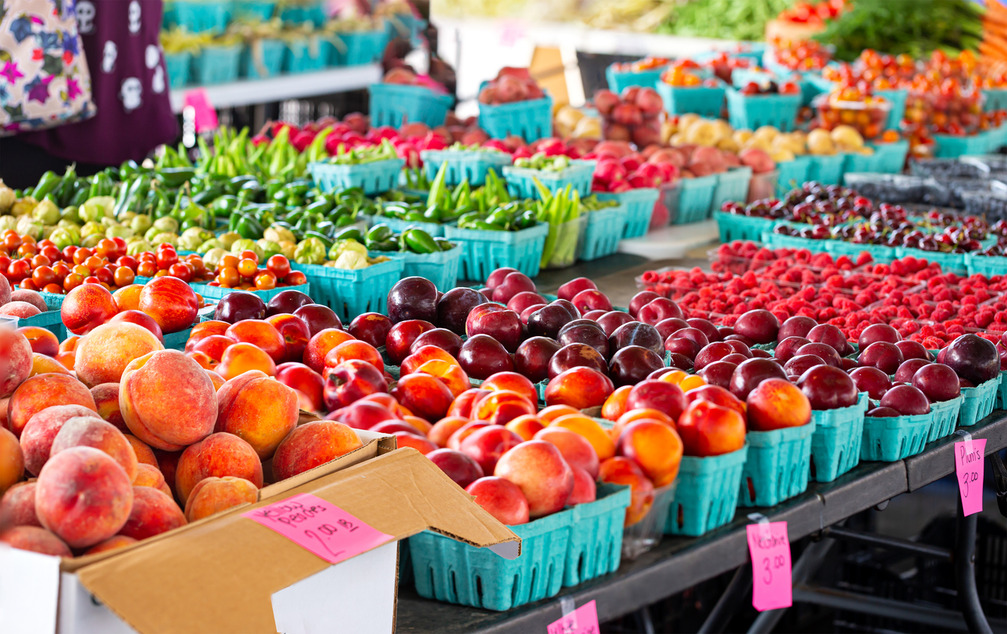
Farmer’s markets create space for interaction in a way few places do anymore. You see neighbors lingering in conversation, kids sampling fresh fruit for the first time, musicians playing on a corner, and dogs patiently waiting at their owner’s feet knowing that a homemade dog treat booth is coming up! It’s not just a place to shop. It’s a place to gather.
The modern resurgence of farmer’s markets in the United States really began to gain momentum in the 1990s and early 2000s, alongside growing awareness around health, sustainability, and local economies. According to the USDA, the number of farmer’s markets in the U.S. has grown significantly over the past few decades, reflecting a shift in consumer priorities. People began asking different questions: Where does my food come from? How was it grown? Who am I supporting when I make a purchase?
Those questions are still driving us today.
Because underneath it all, the renewed love for farmer’s markets reveals something deeper about us as Americans. Despite living in a culture that often celebrates speed, scale, and convenience, there is a growing desire to live more intentionally. To know more. To feel more connected. To choose quality over quantity.
It’s not about rejecting modern life at all. It’s about balancing it.
We still order groceries online because we live super busy lives. We still rely on convenience when we need it. But increasingly, we are carving out space for something more grounded. Something that feels real.
The farmer’s market meets us in that space.
It reminds us that food is more than fuel—it’s a story. That buying locally is an investment in people and place. And that sometimes, the most meaningful experiences are the simplest ones: a conversation, a fresh meal, a morning spent outdoors with no rush to leave.
In the end, our love for farmer’s markets isn’t just about produce or products.
It’s about what they represent.
A slower pace. A stronger connection. A more intentional way of living.
And maybe, in returning to something so old, we’re rediscovering something we didn’t realize we were missing.
A Traditional Lifestyle.
